The shore lies broken, streaked with stains,
A shroud of silence hangs in the air.
The tide, as if in iron chains,
Draws whispers of tacit despair.
But still, they come with candles lit,
To plunge where shadows choke the sea.
A priest absolves the truth unfit
To pierce the dark where faith must be.
“The water’s pure,” one voice insists,
While tar lies thick beneath the wave.
Each ripple twists, each current lists,
A cemetery masked a hollowed grave.
Above, the Kremlin windows gleam,
A watchful gaze, austere and cold.
The master dreams his polished dream,
Where words are sold, and silence told.
Two tankers split, their hulls decay,
The years untended took their toil.
Now oil flows, a blackened spray,
That mirrors the cracks within the soul.
The sea absorbs the hidden cost,
The failure bound in hollow pride.
A spill of lives, a nation lost,
Where truth is cast and facts collide.
And yet, they wade, these hearts of fire,
Through waves where power’s shadow lingers.
Their faith, though noble, climbs no higher
Than what escapes corrupted fingers.
A seabird falls, its feathers slick,
Its wings weighed down, its cries erased.
The shore recoils, its breathing thick,
Its purity, like justice, is displaced.
A speech is made, the stage well-dressed,
To feign concern with careful art.
But power, unmasked, cannot confess,
Its core resides in a hollow heart.
Thousands toil, their hands worn bare,
Scooping sludge from a violated land.
Yet rot endures where none will dare
To break the grip of a ruler’s hand.
Faith shines, unyielding, in the fray,
But light alone can never mend
A world that turns the other way,
Where truth bends endlessly to power’s end.
Audio – Epiphany in Oil
Epiphany in Oil – Author’s Note:
“Epiphany in Oil” is a commentary on the Kerch Strait oil spill and the political, spiritual and environmental contradictions exposed by the disaster. Its immediate journalistic background includes the BBC Verify report of 24 January 2025:
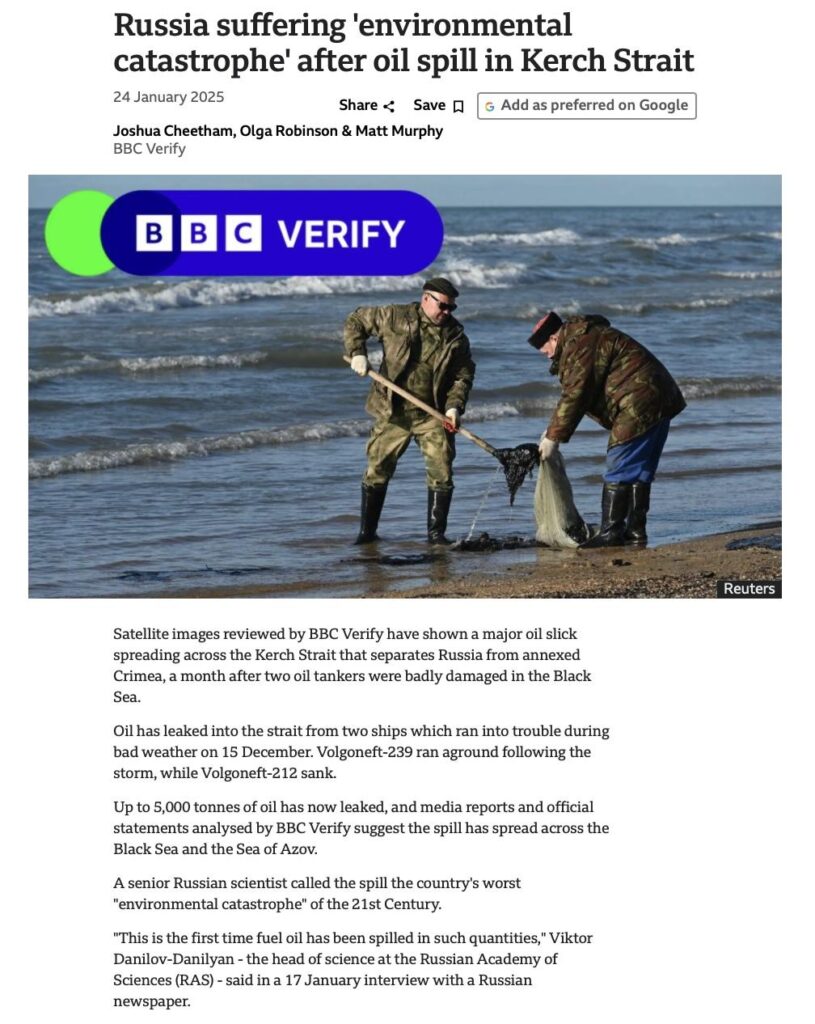
The disaster began on 15 December 2024, when two ageing Russian oil tankers, Volgoneft-212 and Volgoneft-239, encountered a severe storm at the southern entrance to the Kerch Strait. The Volgoneft-212 broke apart and sank, killing one crew member. The Volgoneft-239 was also torn apart: its forward section sank, and its stern eventually ran aground near the Port of Kavkaz. Together, the vessels were carrying approximately 8,450 tonnes of mazut, a dense, low-grade heavy fuel oil. Estimates of the quantity released have ranged from about 2,400 to 5,000 tonnes. Oil began reaching the coasts of the Krasnodar region on 17 December and was subsequently reported along more than 300 kilometres of shoreline and as far west as Sevastopol in Crimea.
On 19 January 2025, Orthodox Christians in Anapa continued the traditional Epiphany immersion in Black Sea water despite the continuing arrival of fuel oil on the surrounding beaches. The ceremony was supervised by a priest. One participant declared that the water was “pure”; only hours later, officials reported that a storm had deposited fresh fragments of fuel oil on the Anapa coastline.
The worshippers entering the dark sea represent sincere and potentially courageous faith, but also the human desire to believe an official reassurance when the physical evidence suggests otherwise. Their candles, the priest and the language of absolution set spiritual purification against a sea that cannot simply be pronounced clean.
Greenpeace argued that the catastrophe could have been prevented had lessons been learned from a similar 2007 accident and obsolete river tankers been removed from maritime service. Thousands of birds were found dead or contaminated, their oil-coated feathers losing the ability to provide flight and insulation. Dolphins and harbour porpoises were also reported dead. Because mazut can sink and contaminate seabed organisms, fish and the wider food chain, Greenpeace warned that some effects could persist for decades. Its later commentary, published in December 2025, returned to the disaster as an example of the relationship between ageing infrastructure, inadequate oversight and Russia’s fossil-fuel economy.
Thousands of volunteers laboured along the polluted shoreline, often manually digging mazut from sand and rescuing affected wildlife. By March 2025, more than 172,000 tonnes of contaminated sand and soil had reportedly been collected.
The oil is both an actual pollutant and a metaphor. It stains the shore, burdens the wings of birds and exposes a deeper contamination, one in which facts are manipulated, responsibility is evaded, and truth is repeatedly made to bend before power.
Return to the Beginning of the Poem
Go to the following poem in the collection: “Flag III (Provocation)“