Trapeze legs do not deflect
Your decedent apathy
The inert embodiment of fashion
A sullen paper cut-out
Detached, at cafe-concert
Budding champagne spears casing dazzling clementine
Smudged oil tobacco stain on glass, on silver, on canvas
A glittering paradox isolated on reflection, in reflection
Crystal mimic of velvet hourglass bodice
In symmetrical solicitous, yet distant stance
Suzon, am I your spectral travelled patron?
Why protect décolletage with a bouquet?
What mystery does the unyielding marble protect?
Ambiguity, commodity, veiled sexual circus
May I procure English ale or your virtue?
Vulgar witness in modern Paris
Confounding new energy and dynamism
Electric bright like sun mirrored moon
The potent, elusive gaze of outer reality
Inner presence held in your world
Illusions of actuality brushed absent
The exposed, vulnerable, hitherto ignored mass
The imagined past of our Belle Epoch
Summon tension in a disjoined frame
Farewell, Édouard, the condensation of truth is, in the expression
Far-removed from a window or mirror before death consumes
Audio – A Bar at the Folies-Bergere
Poem on the theme of the painting – A Bar at the Folies-Bergere by Édouard Manet
A Bar at the Folies-Bergere – Author’s Note:
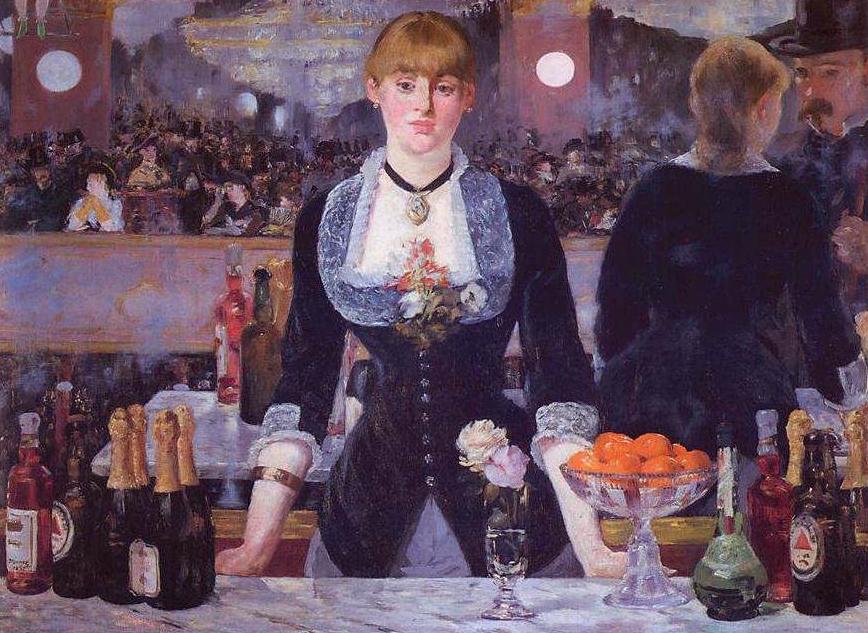
A Bar at the Folies-Bergère (Un bar aux Folies-Bergère) was painted in 1881–1882 by the French Impressionist and Realist Édouard Manet, one of the pivotal figures who bridged Realism and early Impressionism. The work depicts a barmaid standing before a mirror at the famous Parisian music hall, her detached expression and the complex reflections behind her raising questions about perception, modern life, and urban alienation. Completed the year before Manet’s death, it was his last major painting and is widely regarded as a summation of his modern vision, capturing both the glamour and isolation of fin-de-siècle Paris. Today, the painting is housed in the Courtauld Gallery in London. It measures approximately 96 cm × 130 cm.
Return to the Beginning of the Poem
Go to the following poem in the collection: “Accept the Pretty Lies“